Signs your brakes need checking
- Squealing or grinding when you brake.
- Vibration through the pedal or the steering wheel when braking.
- The car pulls to one side under brakes.
- A soft or spongy pedal, or one that sinks lower than usual.
- The brake warning light is on.
- It takes longer to stop than it used to.
Pedal sinking, or metal-on-metal grinding? Don't wait for a booking slot. Call us on 03 5336 1653 before you drive further.
What the brake inspection covers
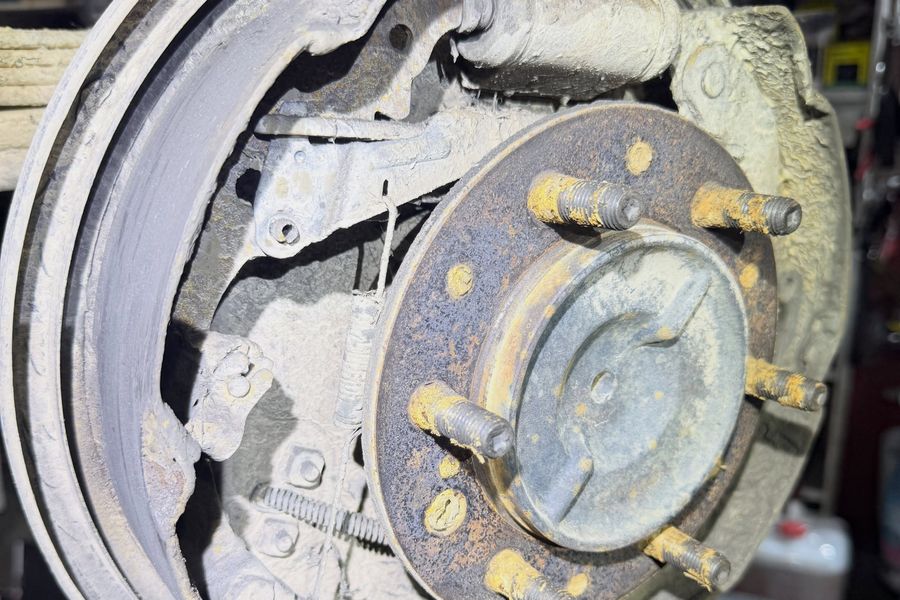
Pads and shoes
Thickness left and how evenly they're wearing.
Discs and drums
Thickness against the maker's minimum, scoring and cracks.
Calipers and wheel cylinders
Leaks, sticking and smooth movement.
Brake fluid
Level and condition.
Lines and hoses
Leaks, corrosion, cracks and chafing.
Park brake
Holds the car properly and adjusts correctly.
Brake fluid: the part people forget
Most brake fluids absorb moisture from the air over time. Water in the fluid lowers its boiling point, and under hard or long braking that can lead to a soft pedal. That's why many manufacturers list a brake fluid replacement in the service schedule, often every two years. We follow the interval for your car.
Suspension and steering
Your suspension keeps the tyres pressed onto the road. When it wears, the car still drives, but it brakes, corners and handles bumps less safely. Signs to look for:
- Bouncing or floating after bumps.
- The nose dives hard when you brake.
- Knocks or clunks over bumps or speed humps.
- Uneven or unusually fast tyre wear.
- Steering that wanders or feels loose.
- One corner sitting lower than the others.
We check the shock absorbers, springs, bushes, ball joints and steering components, then quote for anything that's worn.
The parts we fit
Genuine or OE-spec parts only. Brakes and suspension are safety systems, and your safety isn't a cost saving. If something can safely stay, such as discs that are still above the maker's minimum thickness with a good surface, we'll tell you rather than replace it.